

Dear Evangelicals
A plea for moral common sense

For most of my adult life, I would have happily described myself as an evangelical. My theological convictions were formed in evangelical churches. I spent decades teaching at evangelical institutions. I wrote books defending the faith alongside evangelical scholars. Many of my closest friendships have been with fellow evangelicals. Whatever good I’ve been able to do in my teaching and writing owes much to this community. That is why this is such a difficult essay to write.
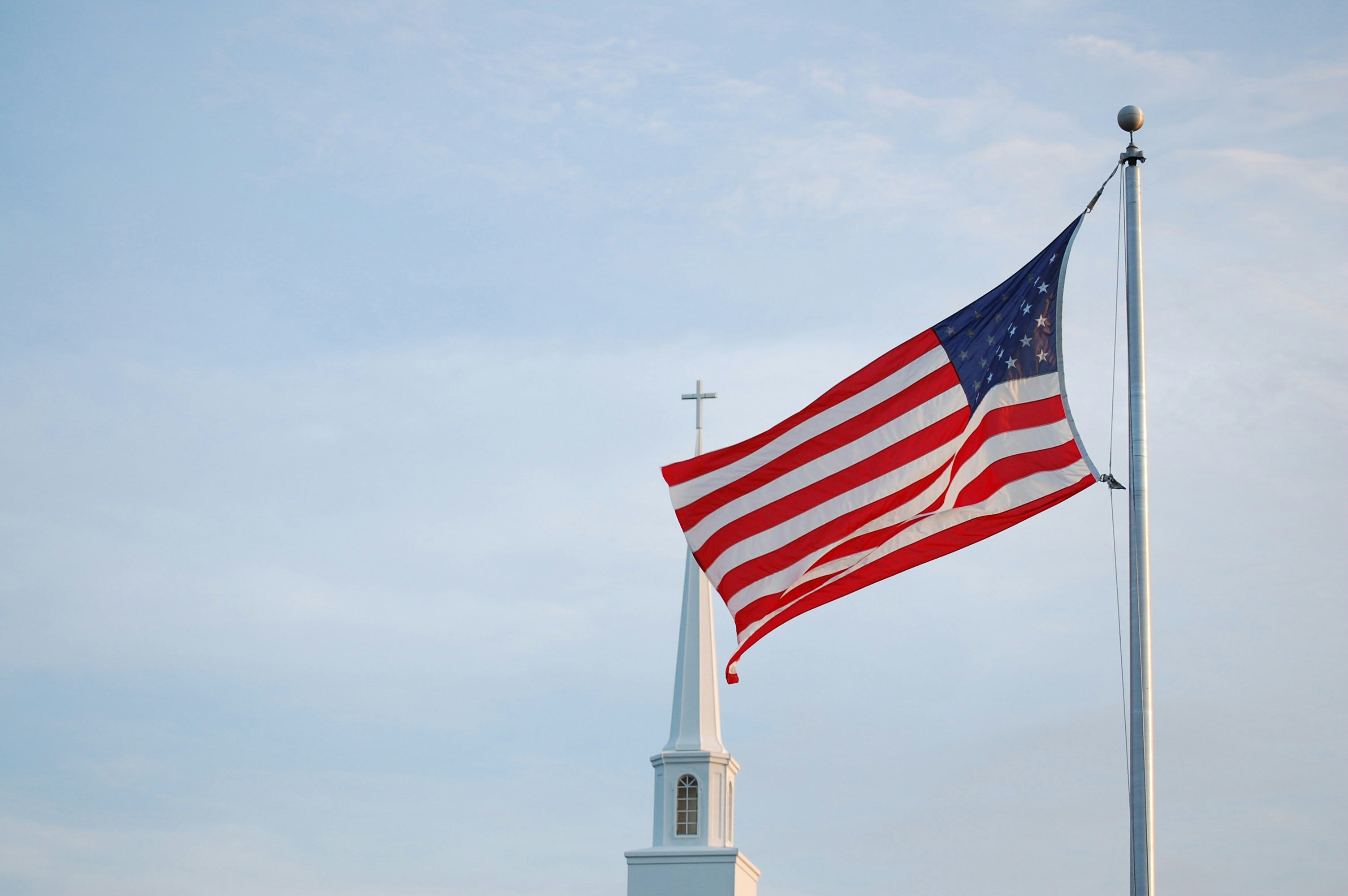
Marybeth and I no longer call ourselves evangelicals, and we want to clarify our reasons. It is not because we have abandoned historic Christian theology, but because we have become increasingly troubled by what the evangelical movement in America has become. Our faith remains intact. If anything, these years have deepened our commitment to Christ. What has changed is our confidence that the evangelical movement is still being shaped primarily by the gospel rather than by politics.
I don’t write this with anger, though I have had to work through quite a bit of it. I write it with sadness. The first intimations of a sea change came years ago while we were at Liberty University. Marybeth discerned before I did that something wasn’t quite right. During the 2016 Republican primaries, our chancellor, Jerry Falwell Jr., became one of Donald Trump’s earliest and most enthusiastic evangelical supporters. At the time, I didn’t think Trump would even win the nomination. When he did, I voted for him. Marybeth voted for a third-party candidate. Looking back, she saw something I was slow to recognize. The next few years, however, provided that difficult but necessary education, especially as we saw the real and devastating consequences of the institution’s misplaced priorities play out, harming faculty and students alike by prizing profits over people and the school’s purported gospel mission.
We left Liberty presuming its problems were largely unique. We accepted positions at Houston Christian University with excitement and gratitude, hoping to help build something wonderful there. Instead, we gradually came to realize that the partisan and fear-driven mindset we had seen at Liberty reflected a much broader pattern within American evangelicalism. Enthusiastic support for Trump, culture-war rhetoric, and increasingly tribal political identities seemed to permeate much of the movement. A form of religious devotion was on full display, but much of the substance seemed displaced by loyalties to political ideologies.
The turning or tipping point for me came on January 6, 2021. Only weeks earlier, I plugged my nose and voted for Donald Trump for a second time. Watching the violence at the Capitol, and then watching the president fail for hours to bring it to an end, fundamentally changed my assessment of him. I had been altogether slow of learning. I concluded at long last that I could never support him again. I assumed many evangelicals would reach the same conclusion.
Instead, four years later, roughly eight in ten white evangelical voters again supported him. That puzzled me then, and it still befuddles and baffles me now. I understand that many Christians believed they faced a difficult choice between two flawed candidates. I understand concerns about abortion, religious liberty, parental rights, and other cultural issues. I have privileged many of those priorities myself over the years. My concern has never been simply that evangelicals voted predominantly Republican.
Rather, I became convinced that many evangelicals had come to excuse or overlook patterns of conduct that they would once have regarded as profoundly disqualifying. Character, we were increasingly told, mattered less than policy. I found that astonishing. For decades, evangelicals insisted that character and leadership were inseparable. Why had that conviction suddenly become negotiable?
As I continued paying attention, my concerns only deepened. I became increasingly troubled by disregard for legal constraints, vindictiveness toward political opponents, habitual dishonesty, war crimes, pedophilia-adjacence, demeaning rhetoric, and an apparent willingness to place personal loyalty above institutional integrity. Even where I agreed with certain policy goals, I found myself increasingly unable to separate those goals from the manner in which they were pursued.
That concern eventually led Marybeth and me to law school. For years my academic work had focused on ethics and the authority of morality. Suddenly I found myself asking a related question: What gives law its authority? What happens when respect for constitutional limits begins to erode? Those questions no longer seemed merely academic. They had become pressing political and existential realities.
Studying law only reinforced our conviction that representative government depends on habits of character every bit as much as constitutional text. At the same time, another realization was dawning. Our departure from evangelicalism was not really about Donald Trump. Trump was the symptom. The deeper issue was that the movement itself increasingly seemed to be shaping theology rather than theology shaping the movement.
We left the movement of evangelicalism, not evangelical theology. I still affirm the historic Christian faith. I continue to hold traditional Christian convictions about marriage and sexual ethics. I continue to believe that unborn human life deserves profound protection. I remain politically moderate-to-conservative on many issues. But I also believe Christians are called to care deeply about justice, honesty, humility, compassion, the rule of law, and the equal dignity of every human being. Those convictions are not distractions from Christian ethics. They are at its ineliminable core.
One area where my thinking has evolved concerns the relationship between Christian morality and public policy. We live in a constitutional, pluralistic, and democratic republic, not a theocracy. Christians should certainly bring their moral convictions into public life, but we should also recognize that persuasion is different from domination. Political victories cannot substitute for moral witness.
That conviction has also changed how I think about issues like immigration. Every nation has the right to secure its borders; I am no fan of a porous border. But Christians should also insist that immigration enforcement respect due process, distinguish carefully among different situations, and treat every person as bearing the image of God. Whenever politics dehumanizes entire groups of people, Christians should be among the first to object. Sadly, evangelicals are often at best mute, at worst complicit.
The same principle applies more broadly. Fear is an understandable human emotion, but it is a dangerous foundation for Christian public engagement. Increasingly I sensed that fear had become one of the defining emotions of evangelical politics: fear of demographic change, fear of cultural decline, fear of secularism, fear of losing influence. Some of those fears are understandable. But Scripture repeatedly calls God’s people not to be governed by fear. Wisdom, justice, humility, courage, and love are eminently better guides than panic.
This has not been merely an intellectual journey. Several of my closest friendships have been deeply strained by these disagreements. These were not casual acquaintances but people I loved, admired, and with whom I collaborated professionally for many years. Losing those friendships has been among the saddest experiences of my life. The issue was never simply partisan disagreement. Rather, I gradually realized that we had come to understand questions of moral judgment and public virtue in fundamentally different ways. I bear no bitterness toward those friends. I remain grateful for all they have meant to me. I simply found that our visions of Christian public witness had grown too far apart.
Today I find myself identifying more with evangelicals like David French, Russell Moore, and Peter Wehner than with many of the loudest voices currently shaping evangelical political discourse. Not because I agree with each of them about everything, but because they remind me that Christians can engage politics without sacrificing intellectual honesty, fruit of the Spirit, or love of neighbor that is more than lip service.
Ultimately, though, this essay is not about personalities. It is about the church, both evangelicals and non-evangelicals. The deepest temptation facing American Christianity is not whether we will vote Republican or Democrat. It is whether we will seek to advance God’s kingdom primarily through the acquisition of political power or through the faithful witness of lives marked by truth, humility, repentance, justice, and love.
The New Testament consistently points us toward the latter. Jesus resisted every temptation to grasp political power. He chose the way of the cross rather than the way of domination. Again and again, he reminded his followers that greatness in God’s kingdom is found in service, not in triumph over one’s enemies.
I worry that much of American evangelicalism has confused those two visions. That is why Marybeth and I no longer call ourselves evangelicals. It is not because we have ceased believing the gospel. It is because the label increasingly communicates political loyalties that no longer describe us.
I do not write this because I have lost hope for evangelicalism. Quite the opposite. I write because I still love the people who shaped me. I remain profoundly grateful for the teachers, pastors, churches, colleagues, and friends who nurtured my faith. My prayer is not that evangelicalism would disappear, but that it would once again become known first and foremost for its allegiance to Jesus Christ rather than to any political persuasion or personality.
Political movements come and go. The church belongs to a kingdom that endures.
One thing I take from this is the power of immediate social contexts. It can be very difficult to break out, even when alternative Xn social and moral visions are immediately adjacent.
Thanks for sharing this. I appreciated how you interacted with the place of fear, and how that has driven Evangelicals into bad places.
My dad used to warn me of the danger of fear. He was a church history professor, and would talk to me about what 'fear of other' created leading up to WW2. He urged me to not give into that fear, and press into faith through tribulation.
My heart breaks by all the compromises I am seeing in Evangelicals. I plead with God to open eyes and renew hearts. In the meantime, I press into orthodox Christianity, and also have deep respect for the likes of Russell Moore and David French.